
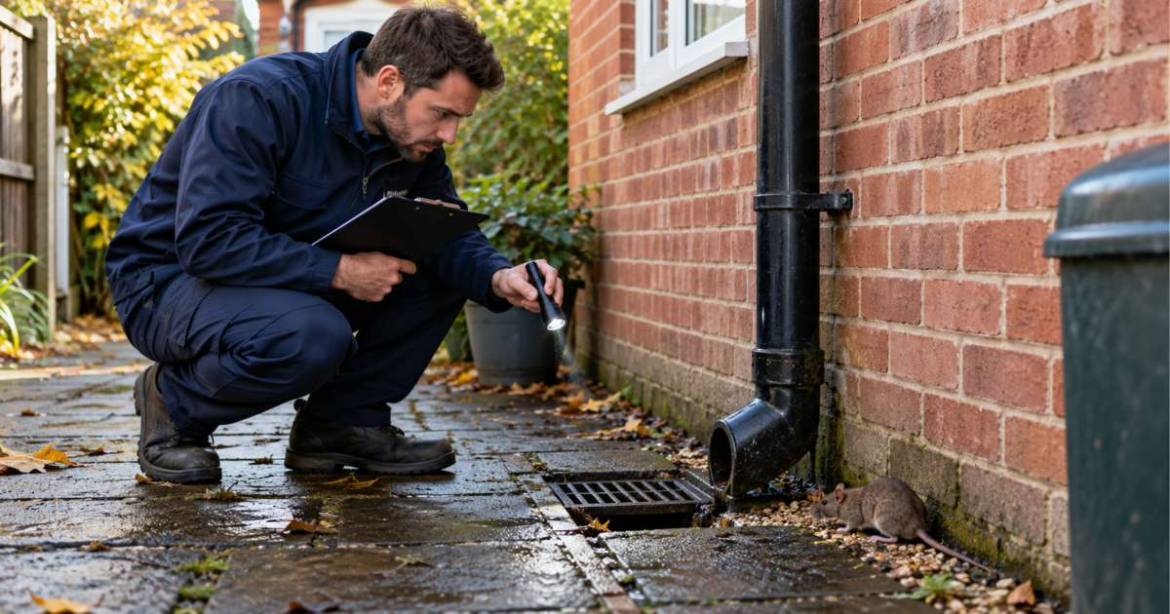
Rats in Drains: How They Get Into Homes and What to Do
Rats appearing inside a house can be frustrating enough. When they keep returning despite treatment and there is no obvious hole in the outside wall, the problem can become particularly difficult to understand.
Sometimes the missing piece of the puzzle is below ground.
Brown rats are strongly associated with drains and sewers. Underground pipework provides sheltered routes through towns, villages and residential areas, and a defect within a property’s drainage system can sometimes allow rats to leave that network and enter the building itself.
This does not mean every rat problem comes from the drains. But when the obvious entry points have been checked and activity continues, drainage should be considered as one possible route.
Key Takeaways
- Brown rats commonly use sewers and drains, and damaged drainage, unsealed redundant pipework or defective access points can provide routes into buildings.
- Repeated rat activity after otherwise successful treatment can justify investigating the drainage system, sometimes with a professional CCTV drain survey.
- Long-term control means dealing with both the active rats and their route of entry. Baiting or trapping alone may not prevent another rat using the same defect later.
Why Are Rats Associated With Drains And Sewers?
The brown rat, Rattus norvegicus, is sometimes called the sewer rat because of its close association with underground drainage systems.
The British Pest Control Association describes brown rats as widespread throughout the UK and specifically advises householders to keep drain inspection covers in good repair and seal disused pipes.
Drains can provide several things rats need: shelter, routes between locations and access to areas where food may be available.
However, a properly constructed and maintained drainage system should normally keep those routes separated from the living areas of a property.
Problems can arise when there is a defect or an unused connection that allows a rat to leave the pipework.
For general information about the species, Wikipedia also provides useful background on the brown rat, although current professional and legal advice should come from UK pest-management and government sources.
How Can Rats Leave A Drain And Enter A House?
There is no single route.
Potential problems can include:
- Damaged underground drainage pipes
- Displaced or defective pipe joints
- Broken inspection chambers
- Damaged drain or gully covers
- Unused pipes that were never properly sealed
- Redundant connections left behind after building alterations
- Defects that allow access into floor or wall voids
The important point is that the rat does not necessarily need to emerge visibly through a toilet or sink.
A drainage defect below the building may allow it into a concealed void first.
From there, rats can travel beneath floors, inside cavities or through other hidden parts of the structure.
That is why a rat heard beneath the kitchen floor may have entered the property some distance from where the noise is actually being heard.
Can Building Work Create Rat Entry Routes?
It can.
Extensions, kitchen alterations, bathrooms, converted garages and other building work frequently involve changes to drainage and service pipework.
An old connection that is no longer required should be appropriately sealed rather than simply abandoned.
A feature published by the British Pest Control Association on rats and drainage systems highlights unsealed redundant pipes as a recurring source of rodent problems encountered during professional drainage investigations.
Interestingly, the problem may not become obvious immediately after the work.
A route can remain unused for months or years before a rat eventually discovers it.
If unexplained rat activity is concentrated around a part of the property that has previously been extended or altered, the history of the building can therefore provide a useful clue.
What Signs Might Suggest The Drains Are Involved?
No single sign proves that rats are entering through the drainage system.
However, certain patterns may justify further investigation.
These include:
- Rat activity repeatedly returning after treatment
- No obvious external entry point being found
- Activity concentrated beneath floors or close to kitchens and bathrooms
- Sounds inside wall or service voids
- Evidence around an old extension or altered part of the property
- Damaged or poorly fitting drain covers
- Known drainage problems
- Disused toilets, gullies or old waste pipes
The first step should still be a proper pest survey.
A professional pest controller can check the more common routes before assuming that a potentially expensive drainage investigation is necessary.
Why Treating The Rats May Not Solve The Whole Problem
Removing the rats currently inside a building is important, but it does not automatically remove the route they used.
The British Pest Control Association recommends an Integrated Pest Management approach that combines control with identifying entry points and proofing.
This becomes particularly important where drains are involved.
If a defect remains open after the original infestation has been controlled, another rat may eventually discover exactly the same route.
That can create a frustrating pattern:
- Rat activity appears
- The rats are controlled
- Activity stops temporarily
- Weeks or months later, rats return
When this happens, simply repeating the same treatment without reconsidering the entry route may fail to address the underlying problem.
Our recent guide to how mice get into lofts and hidden building voids explains the same basic principle: where the pest is found is not necessarily where it originally entered.
When Might A CCTV Drain Survey Help?
Where inspection suggests that the underground drainage system may be involved, a specialist drainage contractor can investigate the pipework.
One commonly used tool is a CCTV drain camera.
The camera is passed through the drainage system so that the operator can inspect otherwise inaccessible pipework for problems such as damaged sections, displaced joints, hidden chambers and redundant connections.
BPCA’s professional guidance on rats in drains describes CCTV as a valuable investigative tool when there is reasonable evidence that a below-ground drainage problem may be responsible.
However, it also makes an important point: a drain survey is not automatically the first step in every rat infestation.
In many cases it makes sense for a pest professional to inspect the property first and establish whether there is enough evidence to justify bringing in a specialist drainage contractor.
Pest Controller Or Drainage Contractor?
Sometimes both are needed.
The two professions deal with different parts of the same problem.
A pest controller can:
- Confirm whether rats are present
- Assess the extent of the infestation
- Identify likely movement routes
- Implement an appropriate control programme
- Recommend proofing measures
- Recognise signs that drainage may require further investigation
A professional drainage contractor can:
- Inspect inaccessible pipework
- Carry out CCTV drainage surveys
- Identify structural defects within the drain
- Locate redundant branches and connections
- Recommend or carry out suitable drainage repairs
The most effective result comes from solving both sides of the problem: the infestation and the defect allowing access.
What Happens If A Drain Defect Is Found?
The appropriate repair depends entirely on the type and location of the defect.
In some circumstances excavation may be required.
In others, specialist techniques such as pipe lining or appropriate sealing systems may allow sections to be repaired without removing floors or digging up large areas.
The drainage contractor should determine the appropriate repair.
From a pest-management perspective, the objective is straightforward: remove the route by which rats can leave the drainage system and gain access to the building.
Once that route has been repaired, the remaining pest-control programme can deal with any animals still inside the property.
Who Is Responsible For Repairing A Drain?
That depends on which section of the drainage system is defective.
Ofwat explains that responsibility for drains and sewers is shared between property owners and sewerage companies.
In general, drains serving an individual property within its boundary are normally the responsibility of the property owner or landlord, while sewerage companies are responsible for public sewers and many lateral or shared sections.
The exact arrangement can vary according to the pipe and its location.
If an investigation identifies a defect, the drainage contractor or sewerage company should be able to establish who is responsible for the relevant section before repair work proceeds.
Can Rats Enter Through An Ordinary Gap Instead?
Absolutely.
Drains are only one possible route.
BPCA advises that rats can exploit openings around 15 mm, so the rest of the building must still be inspected.
Potential entry points can include:
- Gaps around pipes and cables
- Damaged air bricks
- Openings beneath doors
- Broken vents
- Defects around extensions
- Damaged walls or foundations
- Roofline openings where rats can climb to higher levels
Our article Rodents in the Roof: The Hidden Dangers Explained looks at some of the other ways rats can move through concealed parts of a building.
A proper inspection therefore considers drainage as part of the building rather than assuming every rat problem is automatically a sewer problem.
Should You Open A Manhole Yourself?
Caution is sensible.
Drainage systems can contain hazardous gases, restricted spaces and biological contamination.
BPCA’s drainage guidance specifically warns professionals about the risks associated with opening and working around drainage systems.
Householders should not enter manholes or confined drainage spaces.
Where a specialist investigation is needed, using an experienced drainage professional avoids unnecessary exposure and reduces the risk of damaging the drainage system or inspection equipment.
Health And Hygiene Around Rat Activity
Rat activity should also be treated as a hygiene issue.
The NHS confirms that leptospirosis, also known as Weil’s disease in its severe form, can be spread through the urine of infected animals, most commonly including rats.
The disease is rare in the UK, but direct contact with rat urine or contaminated water should still be avoided.
The NHS leptospirosis guidance advises good hygiene and appropriate medical advice where exposure has occurred and symptoms develop.
If rat activity has contaminated loft insulation, voids or accessible surfaces, the affected area may also need appropriate cleaning after the infestation has been resolved.
Our article The Big Clean-Up: Making Your Home Sanitary After a Rodent Infestation contains further information about post-infestation hygiene.
What About Rat Poison In Drains?
Rodenticides are regulated biocidal products and should not be treated as an automatic solution to every drainage-related infestation.
The Health and Safety Executive requires professional anticoagulant rodenticide use to follow recognised UK stewardship requirements.
Those principles include Integrated Pest Management and using rodenticides responsibly where they are demonstrated to be necessary.
Treatment choice therefore depends on the site, the infestation, environmental risks and whether the entry route can be corrected.
Simply adding more bait without resolving a drainage defect can leave the underlying access problem untouched.
What If A Rat Dies Somewhere In The Building?
One complication of poorly planned rodent control is the possibility of a rat dying in an inaccessible void.
That can lead to a persistent odour and, in some cases, secondary insect activity.
If an unexplained smell develops following rodent activity, see our guide Smells Like Trouble: Dealing with Dead Rodents.
Again, understanding how rats are moving through the building can help determine where control should be carried out and where inaccessible spaces may create problems.
Can Food And Waste Still Be The Cause?
Yes.
Finding a drainage route does not mean other environmental factors should be ignored.
Rats still need food, water and somewhere to shelter.
Waste, bird food, animal feed, compost and poorly managed outdoor storage can all help sustain activity around a property.
Our earlier article Rat Pest Control Spotlight – A Feast Fit for a Rat looks more closely at food sources around gardens and homes.
Effective rodent management therefore combines structural inspection with sensible environmental management.
Why Finding The Route Matters
Repeatedly killing rats without discovering how they are entering is not the same as solving the infestation.
A professional investigation should aim to answer:
- Where are the rats active?
- How are they reaching that part of the property?
- Is there an ordinary building entry point?
- Could the drainage system be involved?
- Has previous building work created a redundant connection?
- What needs repairing or proofing?
- How will the site be monitored afterwards?
That investigative approach is particularly valuable when the problem has already been treated once but continues to return.
Professional Help With Rats And Hidden Entry Routes
Rats in drains can turn an apparently straightforward pest problem into a building investigation.
The good news is that the problem becomes much easier to solve once the actual route has been identified.
Avon Pest Control provides professional rat and mouse pest control throughout Warwickshire and surrounding areas.
We can inspect the property, identify signs of rat activity and assess likely entry routes. Where the evidence suggests a drainage defect, a specialist drain investigation may then be appropriate.
The aim is not simply to remove the rats that are present today. It is to understand why they are there and reduce the likelihood of another rat following the same route tomorrow.
If you are repeatedly finding signs of rats beneath floors, inside wall voids or elsewhere in your property, contact Avon Pest Control for professional advice.